Narayana – A Personification of Love & Light
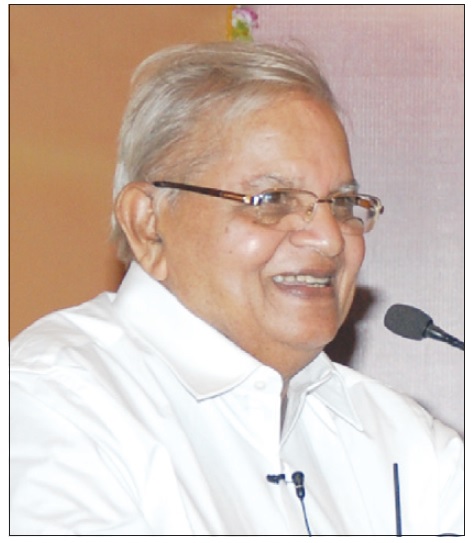
(Adapted from Gurubodh Volume 3: Fragrance of Love and Light, Page 579, Published December 2014)
G. Narayana: Chairman of Companies, Company Director, Corporate and Business Contributor, a path making Author, Trainer and Spiritual Teacher, effective Counsellor and committed Peace Contributor, inspiring leader, loving mentor and insightful exponent of Gita Yoga and other spiritual paths of world has an experience of more than 45 years in the Engineering, Operations, General Management, Corporate Management and Management of synergy of Group Companies and in teaching, human relations and developing leaders.
At present, he is the Chairman Emeritus of Excel Industries Limited, Chairman of Yash Papers Ltd., and Punjab Chemicals & Pharmaceuticals Limited, Director of Aryan Paper Mills Pvt. Ltd., and a mentor to Mahavir Group of Enterprises. He has been Chairman and has been on the Board of several other Companies. He is also an honorary guide to several Medium and small-scale industries and voluntary organizations.
He is the founder of the Indian Institution of Plant Engineers (Maharashtra Chapter) and Sri Seetha Rama Sevasadan, a voluntary organisation, Mantrapuri Veda Vikasa Mandali, Hari Seva Sadan, a social voluntary organisation, and Samarth Vikas Trust in Konkan engaged in community development. He is a Graduate in Electrical and Electronics Engineering and Post Graduate in Management Studies. His learning includes a deep study of the Vedas, the Gita, the Upanishads, and the Dhammapada
and Indian Philosophy, Indian Ethos, Meditation, Tao, and Zen.
He has made visionary and creative contributions in blending the modern scientific approach of management with the holistic Indian philosophy and culture, and contributed for Progress, Development, Growth, and Enrichment of several outstanding Gurus, Leaders, Teachers, and Organisations.
His field of work contribution includes facilitating inter-company stakeholder transactions, conflict resolution, financial restructuring, generation-transition, re-arrangement of shareholding patterns, developing internal entrepreneurship and leader-managers, synergy between group companies, corporate planning, long-range planning, organisational development, responsible business leadership, effective teams, finding optimal solutions, change management, and creating and nurturing organisational culture.
He has led the teams and contributed to the creation and formation of several joint ventures and strategic alliances between Indian promoters or partners with Belgian, Australian, Israeli, and Indian partners.
He is the author of several path-making masterpieces like “Appropriate Integrated Management”, “Stairway to Excellence”, “Responsible Leadership in Gita”, “Strategic Leadership-Chanakya Way”, Excellence in Education”, “Dependence to Freedom”, “Harmony and Disharmony in Life Partnership”, “Harmonious Family”, “Siddhi Yoga – System for Success”, “Appropriate Internal Management”, “Transformation to Transcendence – Breakthrough Ideas for Leadership in the New Millennium”, “Gateways to Self-Realisation”, “Stable And Able”, “Noble Leader – A journey through Dhammapada”, “Seeds of Excellence”, “Inspiring Leadership- A Journey through Parvata Gita – Sermon on the Mount of Holy Bible” and has written many articles on Management, Leadership, Education, Life and spirituality. He has translated “Bhagavad Gita” (Song Supreme) into Telugu and English Poetry and written several articles on Upanishads.
“Namami Bharata Mata” is a song of India visualised by Narayana, which captures the vision of a new harmonious, vibrating, and contributive India and also poetically depicts the mission to attain that vision. While his recent book on Yoga Sutras is like an encyclopedia of Yoga, “Lalitha Sahasranama Bodhamruta Lahari” is like an encyclopedia on Sri Vidya.
He has visualized and created many original concepts related to management and leadership, including “Four Way Thinking System”, “Appropriate Internal Management”, “Appropriate Integral Management”, “Gateways to Self-Realisation” and other processes. His X-ray insights have uncovered and discovered the source codes of the Bhagavad Gita, Ramayana, and Mahabharata.
Dhammapada and “Sermon on the Mount” and helped to develop transcendental change processes, which can facilitate “Change”, Transformation”, and “Metamorphosis” of human personality.
His recent book “Spirit of Tao” with co-authorship of Smt. M.V. Padma and “Krishna the Management Guru” are breakthrough works on spirituality and life. With insightful and visionary approach he complemented, extended and added value in integrating way to the prophesies of Dr. Eric Berne (Transaction analysis – revisited and revised), John Adair (Sparkles of team spirit), Dr. Stephen Covey (Dependence to Freedom), Dr. Wayne Dyer (No limits personality), Dr. Peter M. Senge (Sixth Sense), Adishankaraacharya, (Narayana Shatkam, Nija Moola Shatkam), and Maharshi Veda Vyasa (Nirvahana Gita and Atma Nirvahana Gita).
His “e-books” include “ABCD for Children’, “ABCD for Youth”, “ABCD for Adults” and ABCD for Elders”. His several powerful PowerPoint presentations include “Chakra Vyuha Mantra” for Achieving Excellence, Success and Progress in Present Business and Market Situation, “Taraka Mantra of Transformation” For Delightful Distribution, “Turn-up Strategies for Quantum Success”,
“Manthan-Blue Print Of Corporate World” To Realize Vision 2020 And “Essence Of Ethical Management”. His Books, e-books, tapes, and CD Roms are brought out by Ahmedabad Management Association, email address: ama@ad1.vsnl.net.in .
“Gurubodh” compiled by Shri Hasmukh Upadhyaya, is essence of 477 books and articles of Narayana. “Gurudarshan” also created by Shri Hasmukh Upadhyaya pictorially depicts the journey of Narayana in terms of his initiatives, contributions, practices, and services to Society.
While “Gurubodh” is the essence of what he learned and taught, “Gurudarshan” is the essence of what he did and practiced. It is an example of the implementation of his own mantra, “Say what you do and do what you say.” “Gita Yoga” is a self-realization process and exercise visualized by him after his own transformation in 1983, which he imparted to hundreds of leaders, teachers, and seekers for their own transformation.
He has conducted “Gita Gnaana Yagnas” at Baroda, Ayodhya, Godavari Khani and Manthani (A.P.), thus taking the message of the GITA to people for practice in life. Quotations from his book “Responsible Leadership in Gita” appeared in the Sacred Space column of “Times of India” several times. He was featured in the Magazine “Life Positive” covering the subject of “Spirituality in the Board Room”.
He was invited to speak at the Vision – 2000 Conference at Washington and Chicago in 1993, commemorating Swami Vivekananda’s speech at Chicago in 1893. He was a faculty member in the International Executive Programme on “Religion: Conflict or Peace” organised by The University of Peace in collaboration with several Asia Pacific Universities and the United Nations at Mahidol University, Bangkok. During this programme, his book “Humanity to Divinity,” covering the core spiritual essence of all religions of the world, was released. He participated in several national and multinational conventions and seminars and spoke in the areas of Management, Education, Engineering, and spirituality.
He was in Zurich, Switzerland, in October 2004 to receive the prestigious “International Spirit at Work Award” on behalf of Excel, where he contributed to spirituality in the Board, Management, and Work. In this connection, his book “Rays and Ways of Human Spirit” has been released.
As an active supporter of the Baroda Management Association, he has made significant contributions to the National Management Conventions as the Convention Director and to Chief Executive Conferences as Conference Director. He has contributed to revitalizing and developing the Management Library of the Baroda Management Association and creating and supporting libraries
in several organisations, institutions, towns, and villages.
In association with Ahmedabad Management Association, Ramakrishna Mission, Chinmaya Mission, Symbiosis, Baroda Management Association, and Institution of Public Leadership, he has contributed to spreading the movement of Indian Ethos in Management and New Approaches to Management and Leadership Processes. Visited several countries on Business, Educational and Spiritual Missions.
He has travelled as a missionary to distant parts of the country to train thousands of teachers and educators on the subjects of “Excellence in Education” and to inspire teaching staff. He made valuable contributions and played a key role in making the Vedic Conferences at Manthani Dharmapuri, Yadagiri, Godavari Khani, and Mahboobnagar a great success.
He was felicitated by Baroda Management Association, Ahmedabad Management Association, Excel group of Companies, Nirlep Industries, Mahavir group of enterprises, and other social and educational institutions for his outstanding contributions to the Management movement and Community development work. “Guru Narayana Centre for Leadership” was established by Baroda Management Association in honour of his contributions, in February, 2004, at Baroda.
Sri Seetha Rama Sevasadan, established by him, is an example of service to humanity in the areas of caring for elders, women, and children, tree plantation, ambulance services, children’s garden, health care, and transformation through publications related to values and principles.
“Mantra Puri Darshan” Heritage House, created with his vision, is a classical reflection of the civilization, culture, and heritage of Manthani. His search and research about “Manthani Inscription” and “Gaya Inscription” brought out many revelations about Manthani and Kakatiya history, “Saraswati Shishu Mandir” School building, “Shashi Krupa Bala Vikas Kendra”, “Asha Jyoti Mahila Vikasa Kendra”, and “Muddu Ramakrishniah Yuva Jana Vikasa Kendra”, which are landmark examples of multifaceted services and development facilities created with a missionary spirit by Sri Seetha Rama Sevasadan with his inspiring and visionary inputs.
Narayana is an outstanding Teacher, Guru, Master, Mentor, and Visionary dedicated to assisting humanity to levels of divinity. He was honoured in 2008 by the Government of Andhra Pradesh for his vision and scholarship as related to the Vedas and the Upanishads.
He is recognised and respectfully called as “Guruji” “Arsha Vidya Vibhushana”, “Soujanya Premashraya”, “Sarva Vedanta Daksha”, “Vedodharaika Diksha”, “Pitamaha”, “Mahatma”, “Brahmiparayana”, “Visionary”, “Maharshi”, and “Prophet” by the Industry, laureates, Yogis, Acharyas, Seers, Baroda Management Association, and C.P. Brown Memorial Library and International Conferences.